Everyone has a favorite version of Windows—and one they love to hate. PC Gamer Ranked
 our ridiculously comprehensive lists of the best, worst, and everything in-between from every corner of PC gaming.
Does Bill Gates have a favorite version of Windows? If I had to guess, it would be Windows 95—he's probably still really proud of the Start menu and enjoying the billions of dollars he made when Microsoft's stock exploded. Or maybe he's feeling wistful about life and just wishes we could all go back to simpler times and Windows 3.1. Maybe he uses a Mac these days.
We didn't ask Bill to rattle off his favorites, but with Windows 11 upon us, it felt like the right time to look back at the 35-year history of Windows and rank them all. There have been dark days (Games For Windows Live) and joys we've all shared (that thing the cards do in Solitaire). Mostly, there's been a lot of clicking that button that stops Windows Update from rebooting.
THE CRITERIA
What's included: Every consumer version of Windows (and one professional version that enough normal people ended up using).
What's not included: Business-focused versions of Windows NT. Windows Server. Windows Embedded. Minor variants like Windows XP 64-bit (which sucked, by the way). Windows Phone, obviously.
And now: every version of Windows ranked from worst to best.
13. Windows 8 (2012)
MICROSOFT FOCUSES ON TOUCH, ALIENATES PC USERS EVERYWHERE 
•
We all played: The same games we were playing on Windows 7 because we kept using it
•
How we installed it: 8GB+ USB drive or Windows Update
•
Best screensaver: Mystify, an old classic that let us pretend we were using a different version of
Windows
•
Space required: 20GB
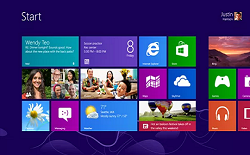
Coming off the enormously polished, successful, and beloved Windows 7, Microsoft did the inevitable: screwed it all up. Windows 8's obvious missteps make a lot of sense in hindsight. The early 2010s were a time of huge and rapid change for the tech industry, mostly because the success of smartphones and tablets (specifically, iPhones and iPads) broke everyone's brains. Pundits called for the death of the PC. Everything needed to have a touch screen. Microsoft looked at the enormous success of Apple's combined software and hardware businesses, specifically the App Store, and said "We want that."
And so was born the worst version of Windows: an OS built for both desktops and touchscreen laptops that didn't excel on either. An OS that wanted to control (and sell) all applications through the new Microsoft Store, despite Windows' legacy as an open platform. Microsoft tried to solve Windows 8's most egregious UI issues with Windows 8.1 in 2013, backpedaling to bring back the taskbar Start button. It made Windows 8.1 more usable, but it was still an awkward blend of desktop and tablet interface.
The stagnant adoption reflected that. According to NetMarketshare, by spring 2015, right before Windows 10 was released, 8 and 8.1 combined had only 14% of the PC market. Windows 10 would pass that percentage within a year.
Wes: This was Microsoft at its absolute worst, a lumbering misguided company trying to put its finger in every tech pie and managing to spoil all of them at once. I hated the Windows 8 user interface on PCs, but I'll give Microsoft credit for one thing: it was actually pretty great on smartphones. Windows Phone deserved better!
Tyler: Wes, no. I had a friend who loved his Windows Phone, but think of the cost we'd be paying now had Microsoft successfully gone down Apple's path. Do you want us to live in an alternate universe where Tim Sweeney is taking Phil Spencer to court to testify about WindOS App Store policy?
Morgan: I always thought it was weird that the "Metro" interface was quarantined to its own zone on the Start menu. The best thing I can say about Windows 8 was it eventually became Windows 8.1, which I had few complaints about. That was the point at which I could tell friends running into compatibility issues in Windows 7 that, don't worry, Windows 8 isn't that bad anymore.
Chris: As soon as I saw all the rectangles and squares I thought: "I am in deep trouble." I have still never owned a tablet.
12. Windows Me (2000)
THE BUGGY ONE YOU NEVER USED, IF YOU WERE LUCKY 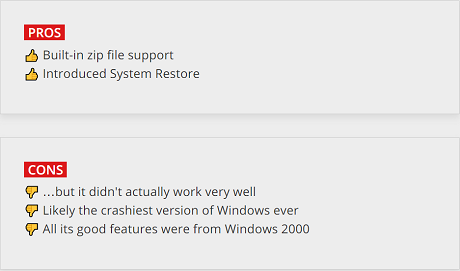
•
We all played: Whatever games our relatives who bought a crappy Pentium III Gateway from Wal-
mart happened to own.
•
How we installed it: 1 CD-ROM
•
Best screensaver: The one confusingly called Windows, which assembles a cubed 3D depiction of
your current desktop block-by-block
•
Space required: 320MB
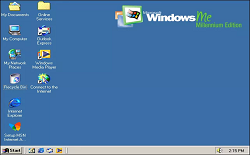
You know it's not a good sign when a version of Windows lasts less than a year. Windows Millennium Edition is truly a perfect name for a poorly aged of-its-time piece of software. Seriously, ME is so 2000, its installation CD was holographic. The information superhighway, here we come!!
Windows ME was meant to be the successor to the Windows 95/98 line. It was, in the sense that it collected all the bugs and problems of those versions and combined them into one perfectly crappy operating system. In practice, it looked about the same as Windows 98, and none of the new features it introduced did much to compensate for the infamous instability. ME crashed. It crashed a lot. It made Windows 95 look stable. At least, that was the experience for a lot of people—if you scored the driver and hardware lottery, it may have run just as well as Windows 98.
Perhaps the gravest sin ME committed was limiting user access to DOS despite being the final Windows operating system built on top of DOS. It ended a groundbreaking era of Windows with a whimper, but XP came in with a bang just barely a year later.
Morgan: I might've used this at school when I was four?
Tyler: Remember when Windows Media Player had that ugly UI with rounded edges, like something out of 3D Movie Maker? That's what I associate with Windows ME. A lot of anime VCDs were watched in that thing. It also had that amazing skin that was a green face with speakers for ears and a visualizer in the braincase. Media Player Man finally found his soulmate a few years later when the words "Evanescence - Bring Me To Life" entered the world.
Wes: Basically all I remember about ME is that a family friend had a computer running it, and it reliably crashed pretty much every time I used it. This was the version of Windows for chumps, while those in the know landed on the rock-solid Windows 2000 until XP came along (and got its first few patches).
11. Windows Vista (2006)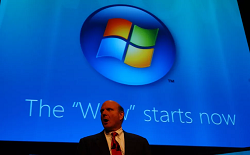
DUUUUUUDE. TRANSPARENCY! 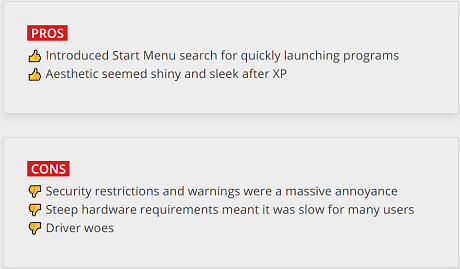
•
We all played: Crysis, BioShock
•
How we installed it: 1 DVD
•
Best screensaver: Ribbons
•
Space required: 20GB
These days I think people look back on Vista with some sympathy. As Linus Tech Tips argued, Vista didn't entirely deserve its bad rap.
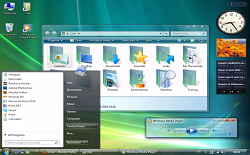
There were certainly some painful performance issues at the start; Vista was certainly more demanding than Windows XP, and some systems that were touted as being able to run Vista really couldn't… or they only could if you turned off all the graphical niceties, like the Aero transparency effects. And Vista was such a major overhaul of the OS coming from XP, Vista needed entirely new drivers which were slow to arrive. That meant some hardware just didn't work on Vista and many games ran far worse than they did on XP. It was a terrible launch.
Oh, and the wonderful User Account Control pop-ups! Yeah, everyone hated those, and no one understood why Vista was taking over your entire screen to warn you every time you tried to change a setting in the control panel or launch a program.
But underneath those very glaring flaws, Vista introduced a huge slew of new features and looked cutting edge compared to XP. It overhauled practically every Windows system from XP. It was a big step forward! In return for that step, you just had to put up with your games running worse, your printer not working, and pop-ups nagging you all the time. The best thing that can be said for Vista is that most of its fundamental improvements returned practically unchanged in Windows 7 just a few years later… and everybody loved them.
Jody: I bought a laptop that came with Vista pre-installed, and it really shouldn't have. That damn OS made it run like arse. Took forever to boot, or do anything really, even with all the swishy nonsense turned off. I'm still mad at Vista like 12 years later.
Morgan: Like Jody, my first laptop ever came with Vista. I remember staring at the little clock widget on my desktop while I waited 15-20 seconds for Minecraft to open. I do not recommend trying to game on a bottom-of-the-line 2009 Dell laptop running Vista.
Evan: It's inseparable from the darkness and suffering of Games for Windows Live, for me. GfWL came a year later, in 2007. I'd peg it as one of the lowest points in PC gaming's history—Microsoft at its least competent as a steward for the platform, and at its most meddlesome. Never again.
Wes: I was somewhat obsessed with the glassy "Aero" aesthetic of Windows Vista and its glossy take on the taskbar and Start button. It looked so high-tech at the time because, whoa, transparency! I definitely installed a Windows XP skin to mimic Vista's aesthetic, but I held out from actually using the OS for a while because it had some fairly heavy system requirements at the time. One of my friends upgraded just to play Halo 2 for PC, which was exclusive to Vista. It wasn't worth it.
Tyler: Like Wes, I was really into the look here. I'd always loved the idea of having little widgets on my desktop, even though I did not then and have never needed a larger clock sitting on the desktop, which I never look at. I guess I just wanted my PC to feel like a control center for, I don't know, someone important.
10-8. Windows 1.0, 2.0, 3.0 (1985, 1987, 1990)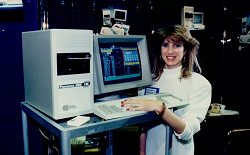
THIRD TIME'S THE CHARM 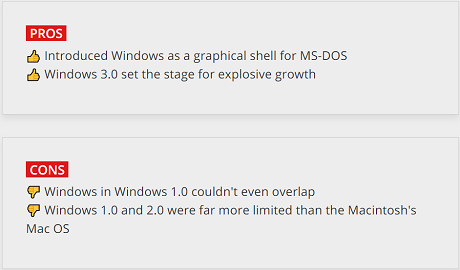
•
We all played: DOS games! King's Quest, Ultima...
•
How we installed it: Five 5.25" floppy disks (1.0)
•
Best screensaver: Flying Windows
•
Space required: 8MB
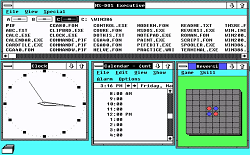
In the early days, Windows was not popular. Or particularly good. As a graphical overlay for MS-DOS, it was limited in what it could actually do; heck, in Windows 1.0, the windows couldn't even overlap. The Macintosh OS was far more robust, and Windows only saw limited use with versions 1.0 and 2.0. 2.0 was an important milestone though: it also saw the introduction of Microsoft Word and Excel and Paint, along with some basics like a calculator, calendar, and card file (if you're under the age of 30, let me introduce you to the Rolodex).
Windows 3.0 is where things really started happening. Up until that point, PC users could do some things in Windows but still had to switch over to the DOS prompt to run many applications. Windows 3.0 (and every version up through 98) was still based on DOS and you'd still have to switch over for some programs, especially to play most games, but it was a big step forward.
And Windows 3.0 was a hit, selling 10 million copies, with a graphical interface greatly improved over Windows 2.0. You could do more than one thing at a time thanks to smarter memory management! It had Solitaire! This was the point where Windows crossed the threshold from being a kinda-useful add-on to DOS, to be a better, easier way for most people to do things on their computer.
Morgan: Wait, Windows is that old?
Wes: Yes, youngling, but like most other '90s kids I feel like the OS practically didn't exist until Windows 3.1. Every computer I used in my early childhood, except the school computer lab Macs, ran Windows 3.1. Except for my dad's really old PC, we kept in the shed to occasionally play games on; that was just DOS. Shout out to Norton Commander for being the first software I learned how to use.
7. Windows 95 (1995)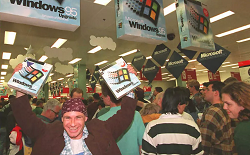
THE ONE WHERE CHANDLER & RACHEL INTRODUCE THE START MENU 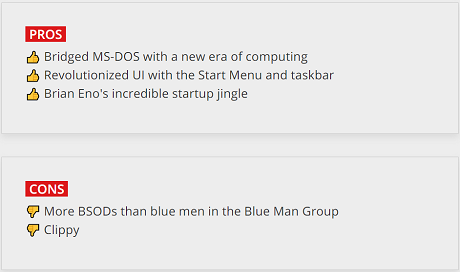
•
We all played: Space Cadet Pinball, FreeCell, Myst
•
How we installed it: 1 CD-ROM or 13 floppy disks
•
Best screensaver: 3D Maze, cuz whoooaaaa
•
Space required: 55 megabytes
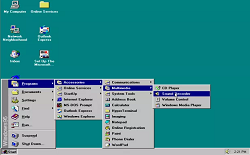
Was the Start menu the biggest advancement in computer UI after the clickable icon? Windows 95 really did feel like a quantum leap in how we used our computers, complex and new enough that it needed a lengthy video from the hottest sitcom stars around to explain how it worked.
So much of what Microsoft introduced in Windows 95 is still key to our PCs today. We still use a start menu, taskbar, and system tray in mostly the same way; those features have proven resilient even to Microsoft itself trying to replace them. Windows 95 set a precedent for compatibility that later versions of Windows would mostly follow, running on top of DOS and still supporting 16-bit applications while being built for a 32-bit future.
And people loved it. Windows 95's adoption was tremendous. By mid-1999, Windows 95 still owned nearly 60% of the PC market, which Windows 98 couldn't hope to surpass. In 1995, Microsoft made about $6 billion in revenue. In 1997, that number grew to more than $11 billion.
Windows 95 certainly had its flaws and was prone to crashing, but that was the price of its innovation. In influence, it's probably the most important version of Windows ever made. Yet it's outranked here by some of its successors because they show how quickly technology evolved from '95-2000; they simply did what Windows 95 did, but better.
Shaun: All I remember is my Uncle Bill being extremely angry about Windows 95 for some reason that was inexplicable to me at the time.
Evan: Vivid memory of seeing the Start button for the first time on a desktop in my uncle's basement and being afraid to push it. I thought it was some kind of ignition. (I was 10.)
Chris: I remember the commercial about the Start button. It was a button, and they made a commercial for it using a Rolling Stones song about being horny. I wonder if Bill Gates knew it was a song about being horny.
Rich: The first 'modern' OS I used. Before this, it was commands and tape loaders. I know Windows was 'old' by this point but it was new to me, and I still remember the amazement at the idea of Windows itself.
Wes: I played Tomb Raider on Windows 95, and remember learning to hate the new Windows key on the keyboard. One accidental press would crash the game. Now it's one of the best keys, though.
6. Windows 98 (1998)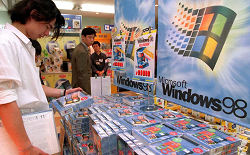
WINDOWS 95, REFINED AND READY TO SURF THE WEB 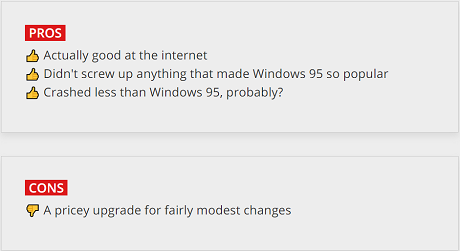
•
We all played: Age of Empires 2, Unreal Tournament
•
How we installed it: 1 CD-ROM or 38 floppy disks
•
Best screensaver: 3D Pipes (we matured past the maze, you see)
•
Space required: 255MB
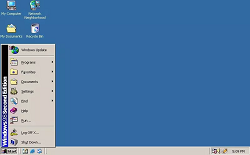
By the time Windows 98 arrived, Microsoft had introduced Internet Explorer and evolved it to version 4.0. Back in '95 Microsoft was just getting an inkling that the internet might really be a thing, but it couldn't finish Internet Explorer in time to ship it with the initial launch of Windows 95. By 1998 it was a core part of the operating system (later the impetus for a huge antitrust lawsuit), and Windows 98 was overall better designed for internet connectivity.
Windows 98 looked pretty much the same but introduced some important features like the Windows Driver Module and better USB support that would become more popular in its successors. 1999's Second Edition further refined the OS. Looking back, Windows 98 is the predecessor to Windows 10's meatiest seasonal updates or the tick-tock cadence of Vista-to-7 and 8-to-10. It wasn't groundbreaking, but it made key upgrades that kept the OS competitive and compatible with the latest hardware during times of rapid change.
Evan: It's around this moment that the second generation of 3D games was kicking off: Tribes, Thief, Half-Life, and the original Unreal. These games were the avalanche of new ideas started by Quake just a couple of years earlier.
Andy: Windows 98 was just Windows 95 that worked properly. That may not sound like a big deal but you'd be surprised how much people appreciate that kind of incrementalism after two or three years of Win95's bullshit. It was so rock-solid that when ME came along I didn't even think about upgrading, which in hindsight was a bullet dodged but at the time was simply a testament to how right Windows 98 was.
source

