Free unofficial patches have been released to protect Windows users from a local privilege escalation (LPE) zero-day vulnerability in the Mobile Device Management Service impacting Windows 10, version 1809 and later.
The security flaw resides under the "Access work or school" settings, and it bypasses a patch released by Microsoft in February to address an information disclosure bug tracked as
CVE-2021-24084.
However, security researcher Abdelhamid Naceri (who also reported the initial vulnerability) discovered this month that the
incompletely patched flaw could also be exploited to gain admin privileges after publicly
disclosing the newly spotted bug in June.
"Namely, as
HiveNightmare/SeriousSAM has taught us, an arbitrary file disclosure can be upgraded to local privilege escalation if you know which files to take and what to do with them," 0patch co-founder Mitja Kolsek
explained today.
"We confirmed this by using the procedure described in
this blog post by Raj Chandel in conjunction with Abdelhamid's bug - and being able to run code as a local administrator."
While Microsoft has most likely also noticed Naceri's June disclosure, the company is yet to patch this LPE bug, exposing Windows 10 systems with the latest November 2021 security updates to attacks.
Luckily, attackers can only exploit the vulnerability if two very specific conditions are met:
• System protection must be enabled on drive C, and at least one restore point created. Whether system
protection is enabled or disabled by default
depends on various parameters.
• At least one local administrator account must be enabled on the computer, or at least one "Administrators"
group member's credentials cached.
Unnoficial patches for all impacted Windows 10 systemsUntil Microsoft releases security updates to address this security issue (likely during next month's Patch Tuesday), the
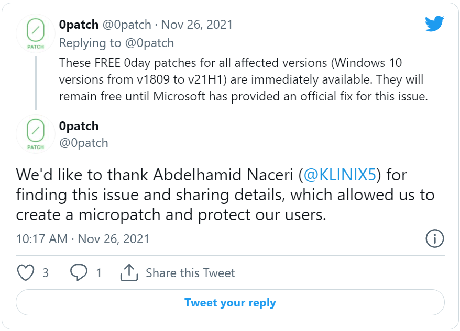
0patch micropatching service has released free and unofficial patches for all affected Windows 10 versions (Windows 10 21H2 is also impacted but is not yet supported by 0patch):
•
Windows 10 v21H1 (32 & 64 bit) updated with November 2021 Updates
•
Windows 10 v20H2 (32 & 64 bit) updated with November 2021 Updates
•
Windows 10 v2004 (32 & 64 bit) updated with November 2021 Updates
•
Windows 10 v1909 (32 & 64 bit) updated with November 2021 Updates
•
Windows 10 v1903 (32 & 64 bit) updated with November 2021 Updates
•
Windows 10 v1809 (32 & 64 bit) updated with May 2021 Updates
"Windows Servers are not affected, as the vulnerable functionality does not exist there. While some similar diagnostics tools exist on servers, they are being executed under the launching user's identity, and therefore cannot be exploited," Kolsek added.
"Windows 10 v1803 and older Windows 10 versions don't seem to be affected either. While they do have the 'Access work or school' functionality, it behaves differently and cannot be exploited this way. Windows 7 does not have the 'Access work or school' functionality at all."
 How to install the micropatch
To install the unofficial patch on your system, you will need to
register a 0patch account and install the
0patch agent.
Once you launch the agent on your device, the patch will be applied automatically (if there are no custom patching enterprise policies enabled to block it) without requiring a restart.
This is the second Windows zero-day that received a micropatch this month after Naceri found that patches for another bug (
CVE-2021-34484) in the Windows User Profile Service
could be bypassed to escalate privileges on all Windows versions, even if fully patched.
Microsoft also needs to patch
a third zero-day bug in the Microsoft Windows Installer with a proof-of-concept (PoC) exploit released by Naceri over the weekend.
If successfully exploited, the zero-day
allows attackers to gain SYSTEM privileges on up-to-date devices running the latest Windows versions, including Windows 10, Windows 11, and Windows Server 2022.
Malware creators have since
started testing the PoC exploit in low volume attacks likely focused on testing and tweaking it for future full-blown campaigns.
source
