 FACEBOOK IS BROKEN, says whistleblower Frances Haugen, who worked on the company’s civic integrity team. In testimony before Congress and in the media, Haugen has argued that the social giant’s algorithms contribute to maladies that range from teen mental health issues to ethnic violence in Ethiopia. There’s no one solution that will fix all that’s wrong with Facebook—no, not even a new name—but one of Haugen’s suggestions stood out. “I’m a strong proponent of chronological ranking, ordering by time with a little bit of spam demotion,” she told the Senate earlier this month. “We should have software that is human-scaled, where humans have conversations together, not computers facilitating who we get to hear from.” Imagine that! Humans … having conversations together. Haugen essentially recommends a Facebook News Feed where items appear as people post them, rather than in an order divined by the company’s algorithmic wizardry. In this world, likes and comments wouldn’t dictate what you see. It’s all a matter of timing—which would also prevent the algorithm from tossing logs onto the platform’s most inflammatory posts. It’s not that radical a notion. Instagram only handed the algorithm the reins to your feed in 2016. Twitter took away chronology altogether that same year, only to reintroduce it as an option in 2018. And you can also ditch the algorithm in the Facebook News Feed right now, today. I know, because I’ve been doing it for the past two weeks. In fairness, it’s not like Facebook hides the option. On desktop, you just click Most Recent in the lefthand pane. On mobile, you’ll find Most Recent under the hamburger menu in the upper-right corner. As Facebook itself warns, though, the experience is fleeting. “You can sort your News Feed to see recent posts,” a company help page says, “but News Feed will eventually return to its default setting.” (Or you can just use this link instead of facebook dot com, and load a ranking-free experience every time.) To get a possibly obvious caveat out of the way: I am by no means a Facebook power user. I’ve posted three or four times a year since 2019, all of which were either WIRED stories or attempts to drum up business for my daughter’s Girl Scout cookie side hustle. My account is private, and while I’m somehow a member of 14 groups, more than half of those haven’t posted anything in the past year, I sporadically check in on three, and had forgotten the rest existed. Still, any honest accounting would put me on Facebook a few times a week. Call it a force of habit, call it Marketplace voyeurism. Regardless, I am familiar with how the News Feed typically functions—and was struck by just how different an experience a healthy dose of chronology imparted. I also don’t want to overstate things. The ills that Haugen proposes chronology may fix are largely not present in my social media bubble, to begin with, at least that I’ve seen. Facebook also uses a multitude of algorithms; here it's referring only to the platform's News Feed ranking. And I hesitate to say whether the experience is necessarily better, at least for me than what Facebook currently has on offer. Far more interesting, anyway, is what it says about Facebook itself. I have 975 Facebook friends, accumulated over the past 13 years or so. I “like” 15 pages, a list that primarily comprises news outlets, plus a few friends who converted their profiles into Pages, and Cheez-Its, for some reason. (The reason is that Cheez-Its are delicious.) You might imagine that in a healthy social network, even in chronological mode, the ratio of posts from friends to brands would roughly reflect the proportion in which you follow them. You don’t even have to imagine, actually; chronological Twitter functions basically like this, with ebbs and flows throughout the day that map the real human activity of the people you follow. More in-depth details can be found on OUR FORUM.  The Federal Trade Commission (FTC) found that the six largest internet service providers (ISPs) in the U.S. collect and share customers' personal data without providing them with info on how it's used or meaningful ways to control this process. "Many internet service providers (ISPs) collect and share far more data about their customers than many consumers may expect—including access to all of their Internet traffic and real-time location data—while failing to offer consumers meaningful choices about how this data can be used," the FTC said. This was found as part of a study, started in 2019, into the privacy practices of U.S. broadband companies and related entities and how they collect, retain, use, and disclose info about consumers and their devices. The six broadband providers included in FTC's report are AT&T Mobility, Cellco Partnership (aka Verizon Wireless), Charter Communications Operating, Comcast (aka Xfinity), T-Mobile U.S., and Google Fiber. The FTC also included in the study three advertising entities affiliated with these companies: AT&T's Appnexus rebranded as Xandr, Verizon's Verizon Online, and Oath Americas rebranded as Verizon Media. Together, the six companies currently control roughly 98 percent of the nation's mobile Internet market, according to the FTC. The FTC also noted that these tech giants have expanded beyond fixed residential internet and mobile internet services into other areas. By including voice, content, smart devices, advertising, and analytics services, they could further increase the volume of customer data they can collect and share with third parties. Troubling data collection, protection, and sharing practices "The report identified several troubling data collection practices among several of the ISPs, including that they combine data across product lines; combine personal, app usage, and web browsing data to target ads; place consumers into sensitive categories such as by race and sexual orientation, and share real-time location data with third-parties," the FTC said. As the FTC further discovered, the ISPs amass huge pools of sensitive consumer data and use it in ways their customers do not expect and could cause them harm, primarily when classifying them by demographic characteristics, including race, ethnicity, gender, or sexuality. Although many ISPs claim to offer consumers choices, the choices they provide are often a sham, at times nudging them toward even more data sharing. "Even though several of the ISPs promise not to sell consumers personal data, they allow it to be used, transferred, and monetized by others and hide disclosures about such practices in the fine print of their privacy policies," the FTC added. "For example, several news outlets noted that subscribers' real-time location data shared with third-party customers were being accessed by car salesmen, property managers, bail bondsmen, bounty hunters, and others without reasonable protections or consumers' knowledge and consent, according to the report." Furthermore, because of their problematic privacy practices and protections, they can be at least as privacy-intrusive as large advertising platforms, given that they have direct access to their consumers' entire unencrypted internet traffic. Even when connecting to sites that encrypt their traffic or using VPNs, ISPs can still collect the domains their customers connect to and analyze their browsing behavior. Turn to OUR FORUM to learn more. 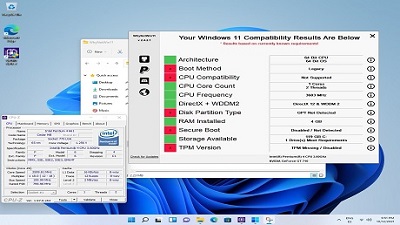 Windows 11 has become one of the most divisive and confusing OS releases in recent history, despite Microsoft's efforts to announce and detail the system's capabilities, requirements, and differences relative to Windows 10. While Microsoft has accompanied communications on Windows 11 with stringent system requirements, there are already numerous ways to circumvent hardware limitations floating through the internet. The latest such experiment, carried out by user @Carlos_SM1995 (via Notebookcheck), actually managed to install and run the OS on supposedly - according to Microsoft - incompatible hardware. What is this mysterious chip that can actually run Microsoft's latest OS? It's an all-powerful, single-core Pentium 4 661 CPU from 2006. It does feature Hyper-Threading, though. To be fair to Microsoft, the system requirements refer to the hardware configurations that can run Windows 11 out of the box, and which can sustain all of its features - including security-focused ones, which were the basis for the Trusted Platform Module (TPM) requirement, and others. It certainly sounds fair to say that Microsoft would finalize its system requirements based on users taking advantage of all of the OS' features - and it really wouldn't make much sense to take any other course of action. Some of Windows 11 security features require specific hardware implementations to run smoothly when they're actually active - but naturally, should those features be disabled, the performance hit doesn't actually register for the end-user. As such, we would say that the fault lies not on Microsoft; as it is one thing to run the OS as intended by the company. The other is to find ways to skirt some of those requirements by disabling features that one will not use - such as TPM, Secure Boot, or Virtualization-Based Security (VBS) features. This is exactly what was done to run this particular Windows 11 OS build and the system even receives updates via the integrated Windows Update functionality, as you can see in the video below. What Microsoft could have done, of course, is clarify which features can be disabled by users in order to achieve broader backward compatibility. But again, it doesn't seem like such a great idea for Microsoft to ship Windows 11 with security-facing features and then tell users how to disable them - that's just not a good IT security practice, period. There are natural risks when disabling OS features - especially security-centric ones, and Microsoft is playing it safe. Yet ultimately, this proves that users can still have control over what hardware they run their Windows 11 build - even if it just so happens that the hardware is a Pentium 4 from 2006. Follow this and more on OUR FORUM. |
Latest Articles
|